
The Retirement Advice That May Not Fit Every Federal Employee
For decades, federal employees nearing age 65 have received nearly identical retirement advice:
«”Enroll in Medicare Part B at 65 and pair it with your Federal Employees Health Benefits (FEHB) plan. Together, they form a gold-standard healthcare safety net.”»
For retirees who spend most of their retirement years in the United States, that advice is often excellent.
Combining Medicare Part B with FEHB can significantly reduce deductibles, copayments, and coinsurance for domestic medical care under many FEHB plans.
But retirement is no longer one-size-fits-all.
Today’s federal retirees are redefining their “Go-Go Years.” Instead of spending their early retirement years primarily managing doctor appointments close to home, many are heading straight to the airport.
They are traveling Europe by rail, trekking through Patagonia, taking safaris across East Africa, spending winters in Latin America, or living abroad part-time.
For this group of active world travelers, an important financial question emerges:
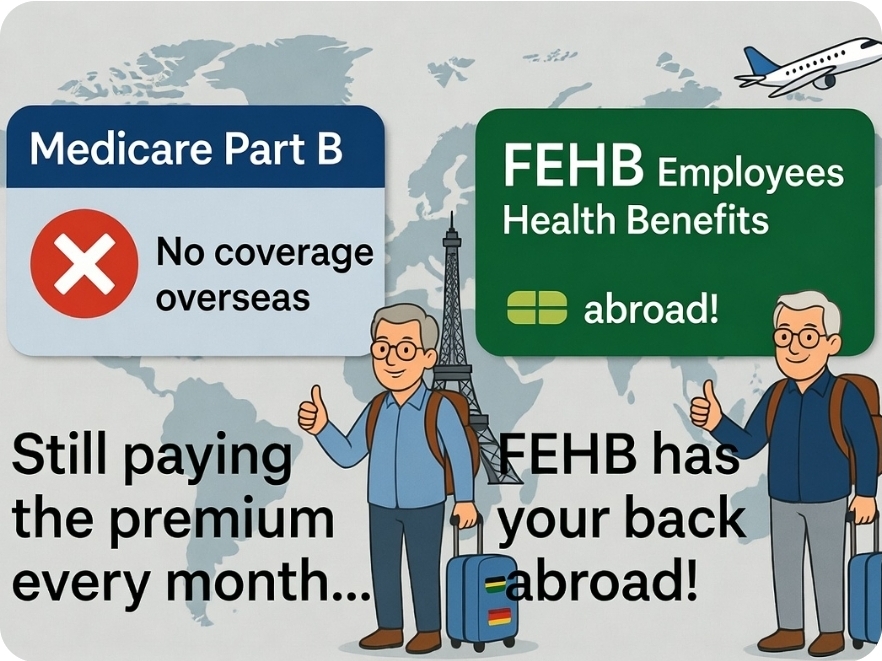
Does it make sense to pay thousands of dollars each year for Medicare Part B when Medicare generally provides no coverage outside the United States?
The Reality: Medicare Coverage Does Not Follow You Around the World
Medicare Has Limited International Coverage
One of the most common misconceptions among retirees is believing Medicare works like worldwide health insurance.
It does not.
Original Medicare generally does not cover healthcare received outside the United States, with only limited exceptions defined by law.
For international travelers, Medicare typically provides no protection for:
– Foreign emergency room visits or hospitalizations.
– Routine medical care or specialist visits abroad.
– Follow-up treatments received overseas.
– Emergency medical care outside Medicare’s limited exceptions.
Yet your Medicare Part B premium continues every month.
Whether you are home in the United States or spending six months exploring another continent, your premium continues to be paid.
The Hidden Financial Cost: Medicare Part B Premiums and IRMAA
Why Successful Federal Retirees Need to Pay Attention
Many federal retirees enter retirement with multiple income streams:
– FERS or CSRS pensions.
– Social Security benefits.
– Thrift Savings Plan (TSP) withdrawals.
– Traditional IRA distributions.
– Capital gains and investment income.
– Spousal employment income.
These income sources can push retirees into higher Medicare Income-Related Monthly Adjustment Amount (IRMAA) brackets.
Because IRMAA uses a two-year lookback period, your retirement income today can affect your Medicare premiums years later.
The Potential Cost of Medicare Part B for Higher-Income Retirees
A married federal couple with higher retirement income may pay thousands of dollars annually in additional Medicare premiums.
At higher IRMAA levels, a couple’s combined Medicare Part B premiums can approach or exceed $10,000 per year.
Over a decade, those premiums could represent more than $100,000 in cash flow that could otherwise support:
– International travel.
– Investments.
– Retirement experiences.
– Other financial goals.
The question is not whether Medicare Part B is valuable.
The question is whether it provides enough value for your specific retirement lifestyle.
The FEHB Advantage: A Rare Benefit That Changes the Equation
Lifetime Access to FEHB Is a Major Retirement Advantage
Federal retirees have an advantage that many Americans do not: the ability to continue FEHB coverage into retirement if they meet eligibility requirements.
This changes the Medicare discussion.
Unlike retirees who rely primarily on Medicare, federal retirees already have a strong healthcare foundation.
Many FEHB plans provide coverage for eligible medical care received overseas, although benefits, reimbursement rules, and limitations vary by plan.
How FEHB Can Help International Travelers
Depending on the plan, FEHB may provide:
Overseas Medical Coverage
Many FEHB plans cover eligible emergency and medically necessary care received outside the United States.
International Assistance Networks
Some FEHB plans provide international assistance services to help members locate providers, coordinate care, and navigate overseas medical situations.
Reimbursement Options
If eligible medical expenses are paid out-of-pocket overseas, members may submit documentation for reimbursement according to their plan’s rules.
Important Prescription Drug Note for International Travelers
Prescription coverage requires special attention.
If a retiree is enrolled in an FEHB Medicare Prescription Drug Program (MPDP) or another Medicare Part D Employer Group Waiver Plan (EGWP) associated with FEHB coverage, those enhanced Medicare prescription benefits generally apply within the United States.
Foreign pharmacy claims typically cannot be processed through the MPDP network.
When traveling internationally, retirees may need to pay for prescriptions at the local pharmacy and then submit eligible expenses through their FEHB plan’s standard overseas prescription reimbursement process.
Always review your specific FEHB plan rules before traveling.
The Risks of Skipping or Delaying Medicare Part B
Skipping Part B can preserve cash flow, but it is not a decision to make casually.
There are important tradeoffs.
1. The Permanent Late Enrollment Penalty
If you decline Medicare Part B at age 65 and later decide to enroll, Medicare may apply a permanent late enrollment penalty.
The penalty is generally calculated as a 10% increase in your Part B premium for each full 12-month period you could have had Part B but did not enroll.
A five-year delay could mean paying a 50% higher premium for the rest of your life.
But the financial penalty is not the only issue.
There is also a timing consideration.
If you decide years later that you want Part B coverage, you generally cannot simply enroll whenever you choose.
You may have to wait for the Medicare General Enrollment Period, which runs from January 1 through March 31, with coverage generally beginning the following month.
For a retiree who reaches age 70 and decides during the “Slow-Go Years” that additional Medicare coverage is needed, that delay can create an administrative and coverage challenge.
2. Losing Potential FEHB Medicare Incentives
Some FEHB plans offer financial incentives for enrolling in Medicare Part B.
Depending on the plan, retirees may receive benefits such as:
– Reduced deductibles.
– Lower out-of-pocket costs.
– Medicare reimbursement incentives.
For retirees who spend significant time receiving healthcare in the United States, these advantages may offset some or all of the premium cost.
3. Planning Around Your Retirement Travel Arc
Retirement often follows three stages:
The Go-Go Years
Active years focused on travel, adventure, and experiences.
The Slow-Go Years
A period where travel continues but at a slower pace.
The No-Go Years
A stage where healthcare needs and domestic care become more important.
A strategy that works during your active travel years may need to change later.
The key is having a plan.
The Bottom Line: Healthcare Should Match the Retirement You Want
The Medicare Part B decision should not be automatic.
It should be intentional.
For federal retirees who plan to spend their early retirement years exploring the world, maintaining strong FEHB coverage—combined with appropriate travel medical and evacuation insurance—may provide a strategy that better matches their lifestyle.
Before deciding:
– Review your FEHB plan’s overseas coverage.
– Understand prescription rules while traveling.
– Estimate your future IRMAA exposure.
– Consider your travel plans.
– Evaluate your expected healthcare needs.
– Think about your retirement timeline.
The best healthcare strategy is not the one everyone follows.
It is the one that supports the retirement you spent decades building.
Coming Next: Part 2 — The Medicare Part B Decision
In Part 2, we will examine the other side of the decision:
– When Medicare Part B may be worth the cost.
– Which federal retirees may benefit most from enrolling.
– How healthcare needs change from the Go-Go Years to the No-Go Years.
– A practical framework for building your own retirement healthcare strategy.
—
Disclaimer: This article is for educational and informational purposes only and does not constitute financial, tax, legal, or healthcare advice. FEHB and Medicare rules are subject to change. Always review current plan information and consult qualified professionals regarding your individual situation.