For many Americans, Social Security represents one of the biggest questions in retirement planning.
Will benefits change?
Will Congress act?
How should Gen X prepare either way?
Those questions have become louder as Social Security faces long-term funding challenges.
Recently, lawmakers introduced the PROMISE Act, a bipartisan proposal designed to create a framework for Congress to address Social Security’s long-term finances. With official projections indicating that Social Security’s primary trust fund reserves could be depleted in the early 2030s—triggering an automatic benefit reduction of roughly 22% under current law if Congress takes no action—proposals like the PROMISE Act show that Washington is beginning to lay the groundwork for action.
The proposal itself does not immediately raise taxes, reduce benefits, or change eligibility rules. Instead, it seeks to move the discussion from political debate toward a formal legislative process.
Regardless of what happens in Washington, one lesson remains clear:
Gen X cannot build a retirement plan on the assumption that today’s rules will never change.
That does not mean panic.
It means preparation.
Social Security Is Important, But It Was Never Designed to Be Your Entire Retirement
Social Security was created as a foundation of retirement income—not a complete retirement plan.
For some retirees, Social Security may provide a significant percentage of their income. For others, especially higher-income households, it may be just one component of a much broader retirement strategy.
A modern retirement plan may include:
– Social Security
– Pension income
– 401(k) plans
– Thrift Savings Plan (TSP)
– Traditional IRAs
– Roth accounts
– Taxable brokerage accounts
– Real estate income
– Business income
The strongest retirement plans are rarely built around a single source of income.
They are built around flexibility.
Why Gen X Faces a Unique Retirement Challenge
Gen X is entering a critical stage of retirement planning.
Many are no longer asking, “How do I start saving?”
Instead, they’re asking:
– Will I have enough?
– When can I retire?
– How do I turn my savings into income?
– How much can I safely withdraw?
– How will taxes and healthcare affect me?
Unlike previous generations, many Gen X retirees will not receive a traditional corporate pension. Instead, they’ll rely on a combination of investments and government benefits.
That means retirement planning becomes less about reaching a target net worth and more about creating a sustainable income system.
The FERS Example: Three Legs of Retirement
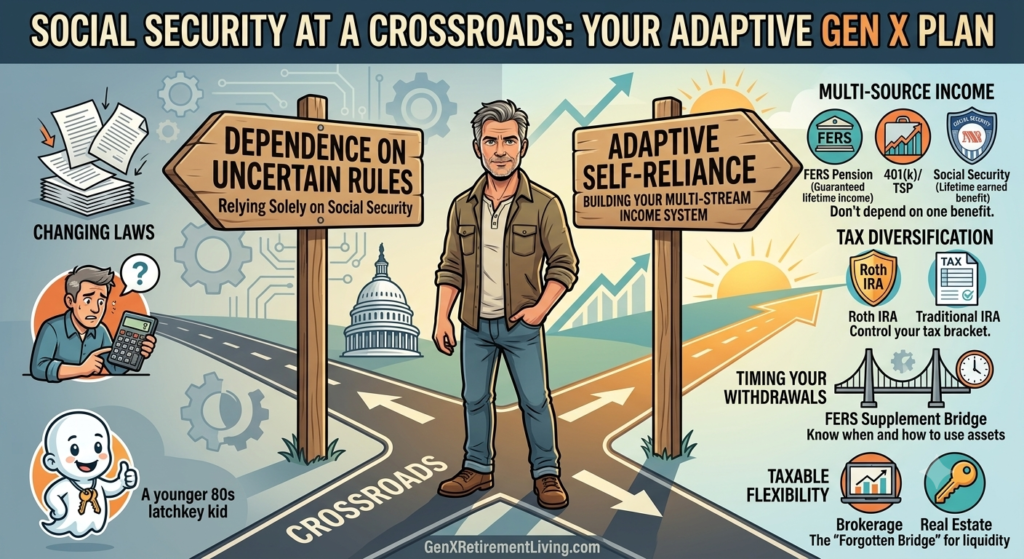
Federal employees covered under the Federal Employees Retirement System (FERS) provide an excellent example of how multiple income sources work together.
FERS is built on three primary components:
FERS Pension: A guaranteed lifetime income stream based on years of service and salary.
Social Security: A lifetime benefit earned through payroll contributions.
Thrift Savings Plan (TSP): A tax-advantaged retirement investment account designed to provide long-term growth and retirement flexibility.
For federal employees, Social Security is not simply an extra benefit—it is one of the three pillars supporting retirement income.
Any future changes to Social Security could influence retirement timing, savings decisions, and long-term income planning.
The FERS Supplement Shows Why Timing Matters
One of the least understood federal retirement benefits is the FERS Annuity Supplement.
For eligible employees who retire before becoming eligible for Social Security, the supplement helps bridge the income gap.
However, it is temporary.
Once the supplement ends, retirees must decide whether to:
– Claim Social Security early
– Withdraw from investment accounts
– Rely more heavily on pension income
– Continue working longer
This illustrates an important retirement principle:
Retirement planning isn’t just about knowing how much money you have—it’s about knowing when and how you’ll use it.
Timing matters.
Building a Retirement Plan Beyond Social Security
The best response to uncertainty is not fear.
It is tax and account diversification.
Having money spread across pre-tax, post-tax (Roth), and taxable brokerage accounts gives you greater control over your income and tax bracket in retirement.
1. Employer Retirement Accounts (401(k), 403(b), 457, TSP)
For millions of Americans, retirement savings are built through employer plans.
These accounts form the foundation of retirement wealth.
But accumulating assets is only half the journey.
The more important question is how you will use those assets once you retire, taking into account withdrawal timing, taxes, and investment risk.
2. Traditional Retirement Accounts (Pre-Tax)
Traditional accounts offer upfront tax deductions and decades of tax-deferred growth.
Eventually, those savings become taxable when withdrawn.
Large withdrawals may affect:
– Federal income taxes
– Medicare premiums (IRMAA)
– The taxation of Social Security benefits
The key is using these accounts strategically within your overall retirement plan.
3. Roth Accounts (Post-Tax Flexibility)
Roth accounts provide valuable tax diversification through tax-free qualified withdrawals, greater control over taxable income, and potential estate planning advantages.
While not a universal replacement for pre-tax accounts, they are a powerful tool for managing tax spikes during retirement.
4. Taxable Brokerage Accounts (The Forgotten Bridge)
Taxable brokerage accounts provide one of retirement’s greatest advantages:
Flexibility.
They offer:
– Access before retirement account age restrictions
– Control over when capital gains are realized
– A bridge between early retirement and Social Security or pension income
5. Real Estate and Alternative Income
Some retirees create additional flexibility through long-term rentals, short-term rentals, or REITs.
When managed carefully, real estate can provide another potential income stream that isn’t directly tied to the stock market.
The Lesson From Previous Social Security Reforms
Social Security has changed before.
The 1983 reforms included adjustments to payroll taxes, benefit taxation, and the gradual increase in the full retirement age.
The lesson isn’t to predict exactly what Congress will do next.
The lesson is to build a retirement plan that can adapt.
Rules change.
Markets change.
Life changes.
Flexibility is one of the most valuable assets a retiree can have.
The Gen X Retirement Mindset
The retirement question for Gen X should not be:
“Will Social Security be exactly the same when I retire?”
A better question is:
“Would my retirement plan still work if something changed?”
That is the difference between hoping and planning.
A resilient retirement strategy combines:
– Guaranteed income
– Investment assets
– Tax diversification
– Multiple income streams
– A realistic spending plan
Final Thoughts
Social Security reform is a national conversation.
Retirement planning is personal.
Gen X does not need to predict every decision made in Washington.
We need retirement plans that are strong enough to adapt to whatever comes next.
Because retirement success is not about depending on one benefit, one account, or one investment strategy.
It is about creating a system that remains resilient through changing laws, changing markets, and changing life circumstances.
The goal isn’t simply to retire. It’s to retire with confidence.
—
Disclaimer: This article reflects my personal approach to organizing retirement finances and is intended for educational purposes only. It should not be considered financial, tax, or investment advice.