The Retirement Decumulation Problem: Why Gen X Needs a Plan to Spend Wealth, Not Just Build It
WWW.GENXRETIREMENTLIVING.COM
The Retirement Conversation Nobody Wants to Have
For decades, Americans have been given the same retirement advice:
Save more. Invest more. Maximize your retirement accounts. Build the biggest nest egg possible.
And those principles matter.
Saving consistently and investing wisely remain some of the most powerful tools for creating financial independence.
But there’s one question that often gets overlooked until retirement is just around the corner:
How do you confidently spend the wealth you’ve spent 30 or 40 years building?
The retirement industry has spent decades teaching people how to accumulate money. It has created endless conversations about reaching $1 million, $2 million, or even $5 million in retirement assets.
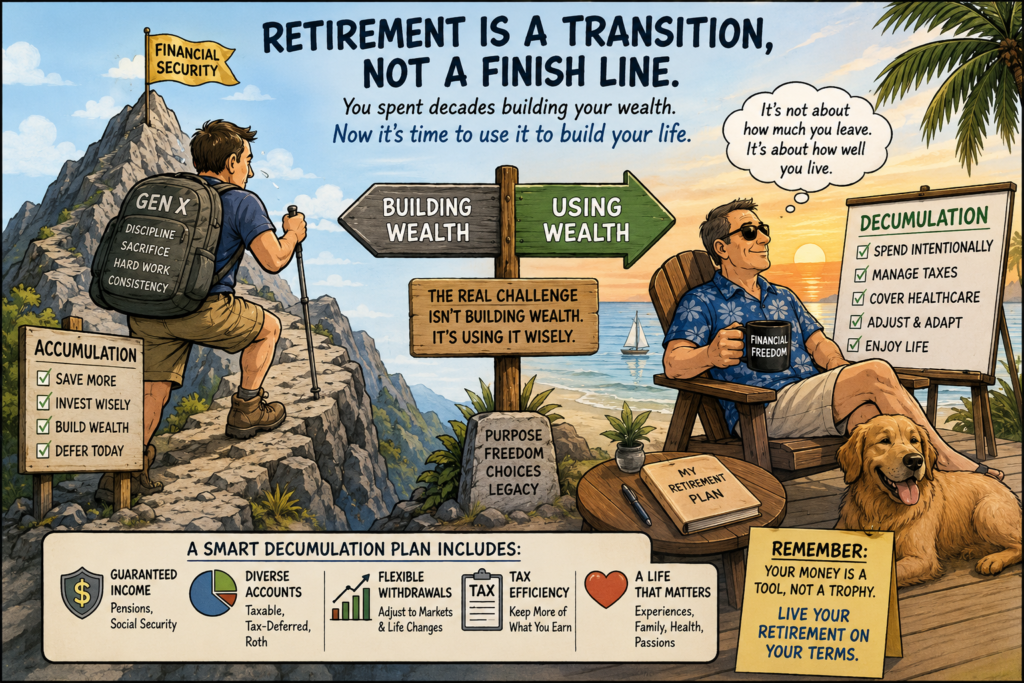
But retirement is not just an accumulation challenge.
It is a transition.
At some point, the question changes from:
“How much money can I build?”
to:
“How do I use this money to create the retirement I worked for?”
That is the retirement decumulation problem.
And for Generation X, this conversation is becoming more important than ever.
As I get closer to my own retirement goals, I’ve realized something unexpected. I don’t worry nearly as much about whether we’ll have enough money. What I think about more often is whether we’ll know how to use it wisely. After decades of measuring success by growing account balances, learning to spend intentionally may be the hardest financial adjustment of all.
Gen X Mastered Saving. Now We Need to Master Spending.
Gen X grew up during a unique financial era.
Many watched their parents retire with traditional pensions while entering adulthood in a world where retirement responsibility increasingly shifted from employers to individuals.
The message became clear:
Your retirement security is now your responsibility.
So Gen X adapted.
We contributed to 401(k)s, TSPs, and IRAs. We invested through bull markets and bear markets. We survived the dot-com crash, the Great Recession, the COVID market decline, and periods of persistent inflation.
Many of us became exceptionally good at accumulating wealth.
But being good at saving creates an unexpected challenge.
It can become difficult to stop saving and start using the money.
After decades of discipline, spending can feel uncomfortable.
The same habits that helped build wealth can sometimes prevent people from enjoying the freedom that wealth was meant to create.
A Large Retirement Account Does Not Automatically Create Retirement Freedom
One of the biggest misconceptions in retirement planning is that your account balance tells the entire story.
It doesn’t.
Two retirees can each have a $2 million investment portfolio and experience completely different retirements.
Someone with:
– A pension
– Affordable healthcare coverage
– A paid-off home
may enjoy far greater financial flexibility than someone with the same portfolio but none of those income sources.
A $1 million portfolio is not a retirement plan.
A $2 million portfolio is not a retirement plan.
A retirement plan is how all the pieces work together:
– Guaranteed income
– Investments
– Taxes
– Healthcare costs
– Housing
– Lifestyle
– Personal priorities
The number matters.
But the strategy matters more.
The Psychological Challenge: Giving Yourself Permission to Spend
The financial side of retirement is often easier than the emotional side.
During your working years, saving money represents security. Watching your investments grow provides reassurance that you’re making progress.
Retirement reverses that equation.
Your investments are no longer just a scorecard.
They become a tool.
The purpose of money changes.
Before retirement:
“Can I build enough?”
After retirement:
“How can I use what I built wisely?”
This is where many retirees struggle.
They spend decades avoiding unnecessary spending, only to reach retirement and continue living as if they are still preparing for retirement.
Financial discipline remains valuable.
But financial freedom requires balance.
The Problem With Chasing the Biggest Possible Number
There is nothing wrong with building wealth.
In fact, wealth creates options.
But the goal should never be accumulating the largest account balance possible simply for the sake of having a larger number.
Money has a purpose.
It can provide:
– Security
– Experiences
– Time with family
– Travel
– Hobbies
– Better health and wellness
– The opportunity to help others
A dollar spent creating meaningful experiences at the right time may provide more value than a dollar left untouched for decades.
That doesn’t mean spending recklessly.
It means spending intentionally.
The “Die With Zero” Conversation Needs More Balance
The idea behind Die With Zero has gained significant attention because it challenges traditional retirement thinking.
Its message is simple:
Don’t spend your entire life building wealth while never enjoying it.
I agree with the spirit of that message.
But I also believe it deserves balance.
The goal is not to leave yourself financially vulnerable.
The goal is not to spend everything.
The goal is to strike the right balance between protecting your future and enjoying the life you’ve worked so hard to create.
A successful retirement plan should answer two equally important questions:
1. How do I make sure I don’t run out of money?
2. How do I make sure I don’t waste the opportunity to enjoy it?
Both questions deserve equal attention.
Retirement Requires a Dynamic Decumulation Strategy
Building wealth and using wealth are two entirely different skills.
A successful retirement strategy cannot rely on one rigid formula.
Markets change.
Tax laws change.
Healthcare costs change.
Family circumstances change.
Your retirement strategy should be able to change with them.
Decumulation isn’t a one-time decision made on your retirement date. It’s an ongoing process that evolves with markets, taxes, health, family needs, and personal priorities.
Market-Responsive Withdrawals
Instead of blindly following a fixed withdrawal percentage regardless of market conditions, a dynamic strategy adjusts based on reality.
During stronger markets, retirees may have greater flexibility to fund travel, hobbies, charitable giving, or larger purchases.
During weaker markets, modest spending adjustments can help preserve the long-term health of a portfolio.
The goal isn’t predicting the market.
The goal is responding intelligently to it.
Coordinating Multiple Account Types
Decumulation also means understanding where your retirement income should come from.
Guaranteed Income
Pensions and Social Security can provide a stable financial foundation.
Taxable Accounts
Taxable investments often provide flexibility during the early retirement years and can support tax planning opportunities.
Tax-Deferred Accounts
Traditional IRAs, 401(k)s, and TSPs provide valuable tax advantages during your working years, but withdrawals require thoughtful planning because Required Minimum Distributions (RMDs) can increase taxable income later in retirement.
Roth Accounts
When withdrawal requirements are met, Roth accounts can provide valuable tax diversification and additional flexibility.
There is no universal retirement formula.
The best strategy depends on your personal circumstances.
Why You Need a Financial Command Center
Why do so many retirees remain stuck in saving mode, even when they’ve accumulated significant wealth?
Because they lack clarity.
When your money is spread across multiple institutions and account types, spending $50,000 for a dream trip or home renovation can feel like you’re losing money instead of simply following your financial plan.
Confidence comes from seeing the complete picture.
A Financial Command Center can help you monitor:
– Net worth
– Cash flow
– Investment balances
– Debt
– Guaranteed retirement income
– Future retirement scenarios
When you understand how all the pieces work together, fear begins to give way to confidence.
The goal isn’t obsessing over every market movement.
The goal is having enough clarity to make informed decisions.
Why Gen X Has a Unique Opportunity
Gen X enters retirement with a perspective unlike any generation before it.
We’ve experienced extraordinary economic change throughout our lives.
We’ve lived through:
– The technology revolution
– Multiple market crashes
– The housing crisis
– Changing employment structures
– Rising healthcare costs
– Rapid technological innovation
We’ve learned one important lesson:
Nothing stays the same forever.
Adaptability became one of our greatest strengths.
That same adaptability will become one of our greatest retirement assets.
After spending decades focused on building financial security, many Gen Xers are now asking a different question:
How do we make our money work for us instead of spending the rest of our lives working for money?
The next challenge isn’t simply growing wealth.
It’s learning how to deploy it wisely.
Retirement Isn’t the End of the Financial Journey
A retirement account balance isn’t the finish line.
It’s a tool.
The purpose of financial independence isn’t spending your entire life preparing for a future you never fully enjoy.
The purpose is to create choices.
Choices about your time.
Choices about your lifestyle.
Choices about your family.
Choices about what matters most.
Building wealth requires discipline.
Spending it wisely requires confidence.
Retirement isn’t the end of the financial journey.
It’s the beginning of a different one.
Gen X spent decades learning how to accumulate wealth.
Now we have the opportunity—and the responsibility—to learn how to use that wealth with purpose.
Because building wealth is only half the journey.
Learning how to enjoy it wisely is the other half.