
WWW.GENXRETIREMENTLIVING.COM
A Few Weeks Ago, I Saw a Retirement Myth Spread in Real Time
A few weeks ago, I was reading through an online retirement discussion when I noticed something that caught my attention.
Someone confidently stated:
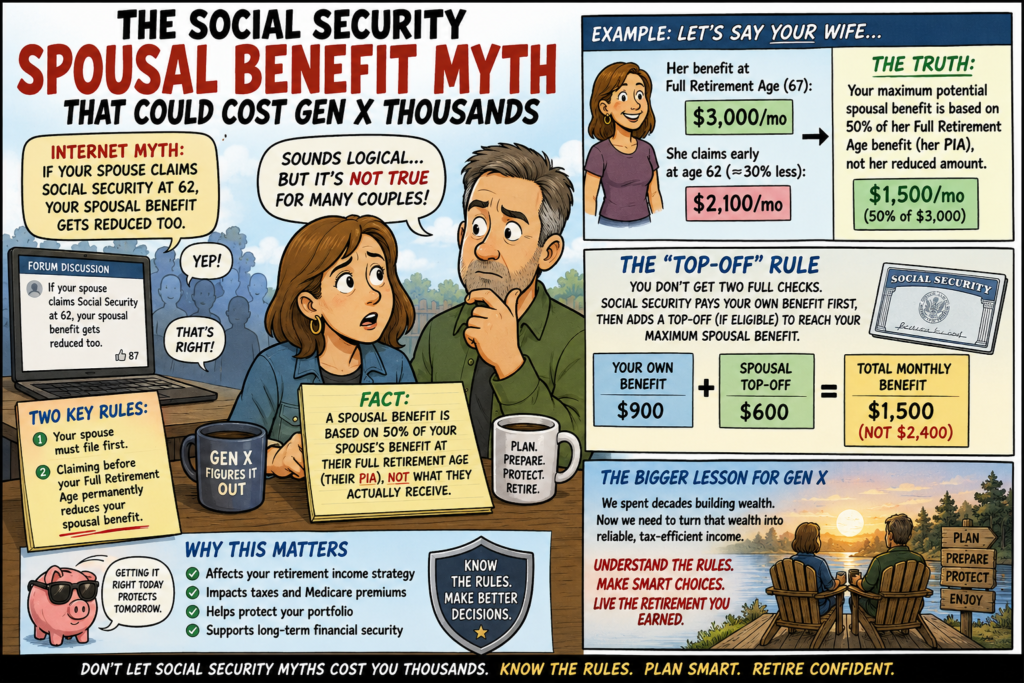
«”If your spouse claims Social Security at 62, your spousal benefit gets reduced too.”»
Within minutes, dozens of people agreed.
The problem?
Much of the advice being shared was either incomplete or simply incorrect.
That’s what concerns me about retirement planning today. Generation X has spent decades learning how to save, invest, and build wealth, yet many of the biggest retirement decisions we’ll ever make are still being shaped by internet myths and oversimplified advice.
As I continue researching retirement income strategies for this blog, one thing has become clear:
Social Security is far more complicated than many people realize.
A misunderstanding about a single rule can affect your retirement income for decades.
That’s why I wanted to break down one of the most misunderstood areas of Social Security: spousal benefits.
Because if there’s one thing Gen X has always done well, it’s separating facts from fiction and figuring things out for ourselves.
The “Figure It Out Yourself” Generation
Generation X has always been the “figure it out yourself” generation.
We came home to empty houses after school. We programmed the VCR without instructions. We balanced checkbooks before online banking existed.
Somehow, we figured it out.
Then retirement planning landed on our shoulders.
Unlike many of our parents, we couldn’t rely on traditional pensions as the primary source of retirement income. Instead, we were handed 401(k)s, IRAs, TSPs, brokerage accounts, and the responsibility of making hundreds of financial decisions ourselves.
Now another important decision is approaching for millions of Gen X couples:
When should we claim Social Security?
Unfortunately, this is where myths often spread faster than facts.
One of the most common sounds perfectly reasonable:
«”If my spouse claims Social Security early, my spousal benefit will also be reduced.”»
It sounds logical.
But for many couples, that isn’t how the rules work.
Understanding this distinction could mean the difference between making an informed claiming decision and leaving thousands of dollars on the table over the course of retirement.
Why Gen X Needs to Pay Attention
Previous generations often relied on three simple retirement income sources:
1. A traditional pension
2. Social Security
3. Personal savings
Many Gen X households have a much more complicated financial picture.
You may have a TSP or 401(k). Your spouse may have a pension. One of you may have a Roth IRA while the other has a traditional IRA. Maybe you also have a taxable brokerage account, rental income, or part-time consulting work.
For many Gen X households, Social Security isn’t just another monthly check.
It’s the income floor that helps support everything else.
– When coordinated properly: It can reduce pressure on your investment portfolio during the early years of retirement.
– When misunderstood: It can lead to unnecessary portfolio withdrawals, higher taxes, or claiming decisions you may later regret.
The Myth vs. the Math
Many people believe a spouse automatically receives half of whatever the other spouse collects.
That’s not how Social Security works.
The maximum potential spousal benefit is generally based on 50% of your spouse’s Primary Insurance Amount (PIA)—the monthly benefit they earned at their Full Retirement Age (67 for anyone born in 1960 or later).
Notice what isn’t in that sentence.
It doesn’t say 50% of the amount your spouse actually receives.
That distinction changes everything.
A Real-World Example
Let’s say your wife has earned a Social Security benefit of $3,000 per month at her Full Retirement Age (FRA).
– She decides to claim early at age 62 because retiring earlier fits your family’s plans.
– Her own monthly benefit is permanently reduced to approximately $2,100 per month.
Here’s where the confusion begins.
Many people assume your maximum possible spousal benefit is now limited to half of that reduced amount—about $1,050 per month.
Not necessarily.
The calculation for a potential spousal benefit begins with her Primary Insurance Amount—the benefit she earned at Full Retirement Age—not the reduced benefit she actually receives.
If you qualify for a spousal benefit, meet the applicable Social Security rules, and wait until your own Full Retirement Age to claim, your maximum potential spousal benefit is generally based on 50% of her Full Retirement Age benefit.
In this example, that would be $1,500 per month.
Her decision to claim early permanently reduces her own benefit, but it does not automatically reduce the benchmark used to calculate your potential spousal benefit.
Like many Social Security rules, individual circumstances can vary depending on your birth year, work history, marital history, and future changes to the law. This example illustrates a common scenario, not every possible situation.
Two Important Rules to Remember
This doesn’t mean every spouse automatically receives the maximum amount.
Two important rules still apply.
1. Your Spouse Must File First
In general, you cannot receive a spousal benefit until your spouse has filed for their own retirement benefit.
Their filing—even if they claim early at age 62—is what makes you eligible to claim a benefit on their earnings record.
2. Your Own Claiming Age Matters
Claiming a spousal benefit before your own Full Retirement Age permanently reduces the monthly amount you receive.
Waiting until your own Full Retirement Age avoids that age-related reduction.
How the “Top-Off” Rule Works
Another common myth is that you’ll receive your own Social Security benefit plus half of your spouse’s benefit.
Social Security uses what’s called a dual-entitlement calculation.
1. Social Security first pays the retirement benefit you’ve earned based on your own work record.
2. If you’re eligible for a higher spousal benefit, it may add a spousal supplement (often called a “top-off”) to bring your total monthly benefit up to the higher amount you’re entitled to receive.
Benefit Type| Monthly Amount
Your earned retirement benefit| $900
Potential spousal benefit| $1,500
Spousal supplement (“Top-Off”)| +$600
Total monthly benefit received| $1,500 (not $2,400)
Why This Matters More Than Ever
This isn’t simply about maximizing a single government benefit.
It’s about protecting your overall retirement strategy.
Claiming Social Security isn’t an isolated decision. It can affect:
– Portfolio withdrawal strategies
– Taxable income
– Medicare Part B and Part D premiums (IRMAA)
– Household cash flow
– Survivor benefit protections for the remaining spouse
The goal isn’t simply to collect Social Security.
The goal is to make Social Security work alongside every other asset you’ve spent your career building.
The Bigger Lesson
Accumulating wealth and living off wealth require two completely different skill sets.
For thirty or forty years, we focused on saving and investing.
The next twenty or thirty years require learning how to convert those assets into reliable, tax-efficient income.
That’s why Generation X needs to shift the conversation.
Instead of asking:
«”How much do I need to retire?”»
We should also ask:
«”How do I turn everything I’ve built into reliable income without making costly mistakes?“»
Understanding the real rules of Social Security is one important piece of that answer.
Final Thoughts
Generation X has never expected retirement planning to be simple.
We’ve adapted to changing careers, shrinking pensions, market swings, and constant financial uncertainty.
Learning the real rules behind Social Security is simply another challenge to solve.
The good news is that internet myths don’t have to become expensive mistakes.
The more you understand how the system actually works, the better prepared you’ll be to coordinate Social Security with your investments, pensions, taxes, and retirement lifestyle.
We spent decades learning how to build wealth.
The next challenge is learning how to turn that wealth into reliable, sustainable income.
Because retirement isn’t won by making the perfect investment.
It’s won by making informed decisions with everything you’ve spent a lifetime building.
Disclaimer: I am not a financial advisor, CPA, attorney, or tax professional. I simply enjoy sharing my personal thoughts, research, and opinions to encourage others to think critically about their own financial decisions. Everyone’s situation is different, so do your own research and consult qualified professionals before making financial, tax, or legal decisions.